
Table of Contents
- My Skin Was Oily AND Broken—Here’s What Fixed It
- What Is Skin Barrier Repair? (Simple Explanation)
- 9 Signs Your Oily Skin Barrier Is Damaged
- The 9 Ingredients That Actually Repair Barriers
- Top 3 Skin Barrier Repair Products Compared
- My Personal Repair Journey
- How to Build Your Oily Skin Repair Routine
- FAQ: Skin Barrier Repair for Oily Skin
I remember staring Skin Barrier Repair at my reflection one morning, barely recognizing the person looking back. My skin wasn’t just dry. It was angry. Red patches flared across my cheeks like I’d been slapped. My forehead felt tight enough to crack when I tried to smile. And the burning—god, the burning—started the moment water touched my face.
I’d spent six months chasing “glass skin.” Retinol every night. Glycolic acid toners. Vitamin C serums stacked with niacinamide stacks with peptide complexes. My bathroom looked like a Sephora exploded, and my skin looked like I’d walked through a windstorm. I canceled dinner plans because I couldn’t make my foundation sit right. And I stopped taking selfies. I started avoiding mirrors.
The breaking point came when my moisturizer—the one I’d used for years—started stinging. Not tingling. Not warming. Actual stinging, like my face was being held over a flame. I remember sitting on my bathroom floor, $400 worth of skincare in the cabinet above me, crying because I’d made everything worse.
That’s when I learned about skin barrier repair. And everything changed.

What Is Skin Barrier Repair? (And Why Your Skin Is Screaming For It)
Your skin barrier—technically your stratum corneum—is the thin, protective outer layer that keeps the good stuff in and the bad stuff out. Think of it like a brick wall. The bricks are your skin cells (corneocytes). The mortar holding them together? Lipids, including ceramides, cholesterol, and fatty acids. Nbcnews
When this wall is intact, your skin holds onto hydration, fights off irritants, and maintains healthy skin pH. When it’s compromised—through over-exfoliation, harsh products, environmental stress, or just bad luck—everything falls apart.
Transepidermal water loss skyrockets. Your skin can’t retain moisture. Irritants penetrate deeper. Skin sensitivity goes through the roof. And suddenly, products that never bothered you before feel like acid. Glamour
Expert Tip: Your barrier isn’t “broken” forever. The stratum corneum completely renews every 14-30 days. With the right support, you can restore, rebuild, and strengthen it—sometimes in as little as two weeks.
9 Signs Your Skin Barrier Is Damaged (How Many Do You Have?)
I didn’t realize how many symptoms I’d normalized until I saw them listed together. Sound familiar?
- Tightness after cleansing, even with “gentle” face wash
- Redness that won’t fade, especially on cheeks and around the nose
- Stinging or burning when applying products (even water sometimes)
- Flaking or peeling that makeup only emphasizes
- Increased breakouts because your skin is overcompensating
- Rough, sandpaper texture where skin used to be smooth
- Dehydration that drinking water doesn’t fix
- Sensitivity to products you’ve used for years
- Dullness—that “flat” look where glow used to live
I had seven out of nine. My moisture barrier was crying for help, and I was drowning it in active ingredients.
The Mistakes That Made Everything Worse (I Did All Of These)
Look, I’m not proud of this. But maybe you’ll recognize yourself:
Over-exfoliating with acids. I thought more was better. AHA at night, BHA in the morning, retinol on weekends. My lipid barrier didn’t stand a chance.
Chasing “squeaky clean.” That tight feeling after cleansing? It’s not cleanliness. It’s your skin barrier function being stripped away.
Skipping moisturizer because I had “oily skin.” Newsflash: oily skin can be dehydrated. When you don’t hydrate and nourish, your skin produces more oil to compensate.
Layering too many actives. Vitamin C + retinol + peptides + acids = chaos. Your skin microbiome needs balance, not bombardment.
Ignoring the signs. That stinging? Not “working.” That redness? Not “purging.” That was my compromised barrier begging me to stop.
The 9 Ingredients That Actually Repair Your Skin Barrier
Not all barrier repair is created equal. These are the ingredients with real skin barrier science behind them—the ones that protect, restore, and rebuild what you’ve lost. Dermapproved
1. Ceramides (The Foundation)
Ceramides make up 50% of your skin barrier’s lipid matrix. They’re literally the mortar in your brick wall. When you apply them topically, they integrate into your stratum corneum and strengthen the structure.
Research from the Journal of Clinical and Aesthetic Dermatology shows that ceramide creams significantly improve skin barrier function and reduce transepidermal water loss within weeks [1].
Expert Tip: Look for multiple ceramide types (NP, AP, EOP) plus cholesterol and fatty acids—they work synergistically, just like your natural barrier.
2. Niacinamide (The Multi-Tasker)
Niacinamide (vitamin B3) boosts ceramide production, reduces inflammation, and improves skin barrier resilience. Studies show it increases lipid synthesis and reduces water loss by up to 24% [2].
Plus? It brightens skin tone and fades dark spots while it repairs. It’s the overachiever of barrier ingredients.
3. Hyaluronic Acid (The Hydration Magnet)
Hyaluronic acid holds 1,000 times its weight in water. But here’s what most people miss: it works with your barrier, not instead of it. When your moisture barrier is intact, HA draws water into the skin and keeps it there. When it’s damaged, HA can actually pull water out—making dehydration worse. Skinfix
That’s why HA needs ceramides and occlusives to work properly.
4. Squalane (The Skin-Identical Oil)
Squalane mimics your skin’s natural sebum. It’s lightweight, non-comedogenic, and creates a protective layer that prevents transepidermal water loss while your barrier heals. Perfect for oily and acne-prone skin that needs repair without heaviness.
5. Fatty Acids (The Sealers)
Specifically linoleic acid and oleic acid from plant oils. They replenish the lipid matrix and improve skin barrier function. Look for evening primrose oil, rosehip oil, or borage oil—rich in barrier-supporting fatty acids.
6. Cholesterol (The Missing Piece)
Your skin barrier is 25% cholesterol. Most people ignore it, but ceramides + cholesterol + fatty acids in a 3:1:1 ratio mimics your natural lipid profile. This isn’t just repair—it’s rebuilding from the blueprint.
7. Panthenol (Pro-Vitamin B5)
Panthenol penetrates deeply, hydrates, and promotes skin healing. It’s especially soothing for sensitive skin and reduces irritation while supporting long-term barrier health.
8. Allantoin (The Soother)
Derived from comfrey root, allantoin calms inflammation, promotes cell turnover, and helps skin recover from damage. It’s gentle enough for the most compromised barrier situations.
9. Beta-Glucan (The Protector)
This polysaccharide forms a protective film on skin, locks in moisture, and stimulates collagen production. It’s particularly effective for sensitive skin and barrier recovery after irritation.
My Personal Skin Barrier Repair Journey
I learned about these ingredients the hard way—researching at 2 AM with a burning face and a credit card full of regrets. The first ceramide cream I tried was thick, greasy, and broke me out. The second sat on top of my skin like a mask, doing nothing. The third smelled like a hospital.
Then I found something different.
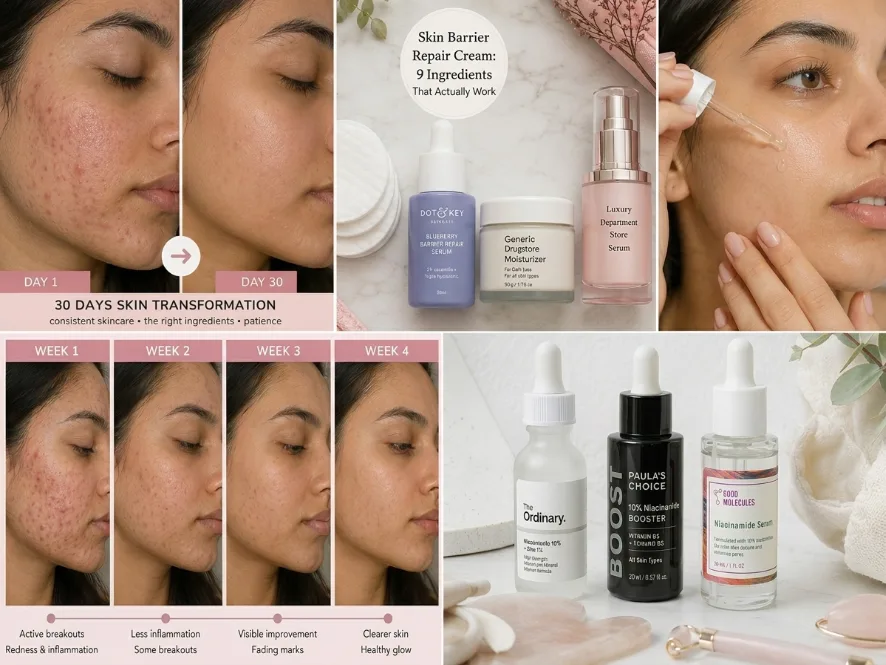
I’d been avoiding serums because I thought my barrier needed heavy creams. But the Dot & Key Blueberry Hydrate 12% Barrier Boost Serum changed my understanding of what repair could feel like. nbcnews
Week 1: The first thing I noticed was the texture. Silky, lightweight, sinking in within seconds. No sitting on top. No greasy residue. My skin drank it up. The tightness after cleansing started fading by day three.
Week 2: The redness calmed. Not dramatically—I’m skeptical of overnight transformations—but noticeably. My cheeks stopped looking like I’d run a marathon. And the stinging? Gone. I could apply moisturizer without bracing myself.
Week 4: This is when I knew something real was happening. I tried a gentle lactic acid exfoliation—something that would have destroyed me a month earlier. No reaction. No redness. My barrier was rebuilding, restoring its natural defenses.
Week 8: I caught myself in natural light without foundation. Plump, glowing, calm skin. The kind of skin that looks expensive without costing a fortune.

Product Comparison: What Actually Works For Skin Barrier Repair
| Feature | Dot & Key Blueberry Barrier Serum | Generic Drugstore Moisturizer | Luxury Department Store Serum |
|---|---|---|---|
| Key Ingredients | 7 Ceramides, Niacinamide, Hyaluronic Acid, Blueberry Extract | Basic glycerin, mineral oil, maybe one ceramide | Single ceramide, fragrance-heavy, silicones |
| Ceramide Concentration | 7 types + 12% active blend | None or trace amounts | 1-2 types, low concentration |
| Texture | Lightweight serum, layers perfectly | Heavy, occlusive, pore-clogging | Silky but loaded with fillers |
| Price Point | Mid-range, accessible | Cheap but ineffective | $80-150, overpriced |
| Size | 30ml concentrated | 50ml mostly filler | 30ml inflated cost |
| My Experience | Visible repair in 2 weeks, zero breakouts | Temporary relief, no real barrier repair | Nice texture, minimal actual improvement |
| Pros | Multi-ceramide complex, niacinamide brightens, HA hydrates, affordable | Available everywhere, won’t break the bank | Pleasant application, luxury feel |
| Cons | 30ml if using AM+PM (stock up!) | No barrier repair, sits on skin | Expensive for minimal active concentration |
| Who Should Buy | Anyone serious about barrier repair + brightening | Budget-only, no major barrier damage | Texture-focused, not results-focused |
Why The Dot & Key Serum Became My Holy Grail
First Impression: The blueberry branding got me—I’ll admit it. But the pump dispenser kept everything hygienic, and one pump was exactly enough for my face and neck. No waste. No dipping fingers into jars.
Texture: This is where I fell in love. Most barrier products feel like punishment—thick, greasy, suffocating. This felt like skincare. Silky, slightly cooling, disappearing completely within 30 seconds. I could layer sunscreen over it immediately. No pilling. No waiting.
The Ingredients In Action:
- 7 Ceramides: Not one or two. Seven different types targeting different layers of the stratum corneum. This is lipid barrier rebuilding at a cellular level.
- 12% Active Blend: High enough concentration to matter, balanced enough for sensitive skin.
- Niacinamide: While the ceramides repair, the niacinamide brightens. My dark spots from old breakouts faded alongside the redness.
- Hyaluronic Acid: Multi-molecular weight means hydration at every level—not just surface plumping.
- Blueberry Extract: Antioxidant protection while you restore.
Results Timeline:
- Days 1-3: Immediate hydration, reduced tightness
- Week 1: Calming of redness and sensitivity
- 2 Week : Visible brightening, barrier resilience improving
- Week 4: Full repair—can tolerate gentle actives again
- Week 8: Transformed skin—plump, resilient, glowing
Honest Limitation: The 30ml size. If you’re using this AM and PM (which I recommend during active repair), you’ll run out in 3-4 weeks. Buy two. Or better—set up a subscription. Your barrier will thank you.
Who It’s Not For: If you want a heavy, occlusive night cream feeling, this isn’t that. It’s repair that feels like nothing—which, honestly, is the point. Barrier healing shouldn’t feel like a chore.
Soft CTA: If your skin is crying out for real repair—not temporary relief, not masking symptoms, but actual rebuilding—this is the serum that finally listens. [Shop Dot & Key Blueberry Barrier Serum Here →]
How To Build Your Skin Barrier Repair Routine
Morning and evening, simplified:
AM:
- Gentle, non-foaming cleanser (no sulfates)
- Dot & Key Blueberry Barrier Serum (2-3 drops, pat gently)
- Moisturizer with ceramides and fatty acids
- SPF 30+ (non-negotiable—UV damage destroys barriers)
PM:
- Oil cleanser (if wearing makeup/SPF)
- Gentle water-based cleanser
- Dot & Key Blueberry Barrier Serum
- Richer night cream with cholesterol and occlusives
- Optional: squalane oil as final layer
During Active Repair (First 2-4 weeks):
- No acids. No retinol. And No vitamin C. Just repair.
- Focus on hydrate, nourish, protect.
- Once barrier is restored, reintroduce actives slowly—one at a time, patch test everything.
Lifestyle Factors That Make or Break Your Skin Barrier
Products are only half the battle. Your barrier also needs:
Sleep: 7-9 hours for cellular repair and skin regeneration. Your stratum corneum renews overnight—don’t rob it of that time.
Water: Internal hydration supports external hydration. Not a magic fix, but necessary foundation.
Stress Management: Cortisol breaks down skin barrierlipids. Meditation, movement, therapy—whatever works for you.
Humidity: Dry air accelerates transepidermal water loss. Consider a humidifier, especially in winter or with AC/heating.
Gentle Handling: No hot water. No rough towels. No picking. Treat your compromised barrier like the fragile ecosystem it is.
FAQ: Skin Barrier Repair Questions Everyone Asks
How long does skin barrier repair take? Minor damage: 2-3 weeks. Moderate: 4-6 weeks. Severe: 8-12 weeks. Consistency matters more than speed.
Can I use barrier repair serum with retinol? Not during active repair. Once restored, reintroduce retinol slowly—alternate nights, never layer simultaneously.
What’s the difference between hydration and moisture?Hydration = water content ( HA, water-based products). Moisture = oil content ( ceramides, oils, creams). You need both for barrier health.
Why is my skin still dry after moisturizing? Your barrier isn’t retaining the hydration. You need ceramides and lipids to seal it in, not just more water-based products.
Can damaged skin barrier cause acne? Absolutely. When your barrier is compromised, skin overproduces oil and inflammation increases—perfect storm for breakouts.
How do I know if my barrier is healing? Less tightness, reduced redness, products stop stinging, makeup applies smoothly, skin feels comfortable all day.
Is niacinamide good for barrier repair? Yes—it’s one of the best. Boosts ceramide production, reduces inflammation, and improves barrier resilience over time.
The Bottom Line: Your Skin Barrier Can Heal
I’ve been where you are. Hiding from mirrors. Wasting money. Losing hope. Believing that “good skin” was something other people had, not me.
The Dot & Key Blueberry Hydrate 12% Barrier Boost Serum changed everything. Not overnight. But consistently. Reliably. Finally.
Your skin barrierCANheal. You just need the right support—and you don’t need to spend a fortune to get it. Nine ingredients. One serum. Real repair.
Your future self—the one who touches her face and feels soft, calm, healthy skin—is waiting. Start your repair journey today.
[Shop Dot & Key Blueberry Barrier Serum — 30ml]

