
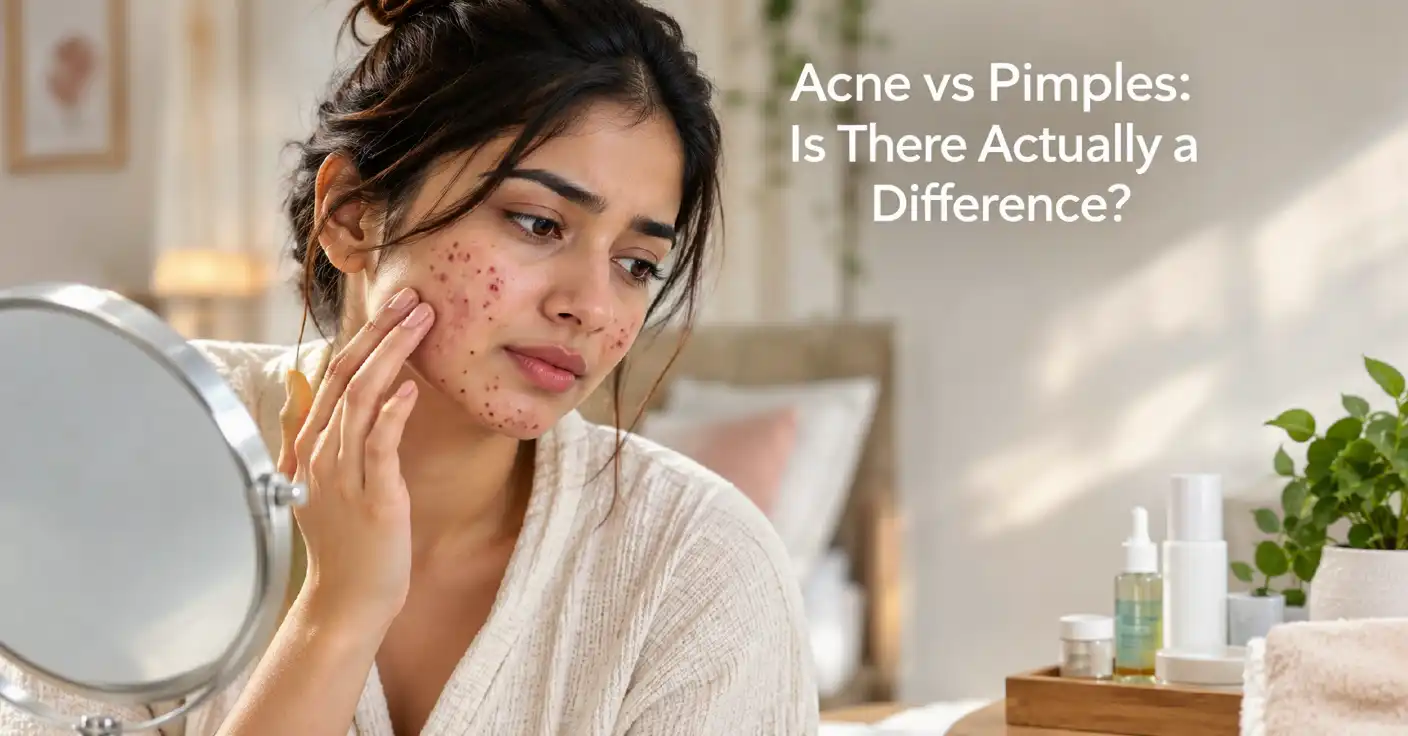
Acne and Pimples: Is There Actually a Difference?
Have you ever looked Acne and Pimples in the mirror, noticed one angry red bump on your face, and wondered:
“Is this just a pimple, or do I actually have acne?”
You are definitely not the only person who has asked that question.
People often use the words acne and pimples as if they mean exactly the same thing. In everyday conversation, that is understandable. But medically, there is a small—and useful—difference. drtanveerfatima

Quick Answer: Acne and Pimples
A pimple is usually an individual breakout, while acne is the broader skin condition that can cause different types of breakouts.
Acne can include blackheads, whiteheads, pimples, pustules, nodules and cysts.
So, a pimple can be part of acne, but the word acne describes something broader than one individual pimple.
Think about it this way:
Pimple = one player.
Acne = the whole team.
That simple distinction makes the rest of this topic much easier to understand.

Acne and Pimples: What’s the Difference?
| Feature | Pimple | Acne |
|---|---|---|
| What it means | An individual breakout | A broader skin condition |
| Scope | Usually one lesion | Can involve many lesions |
| Can occur alone? | Yes | Acne usually involves a pattern of breakouts |
| Possible appearance | Often red, swollen or pus-filled | Blackheads, whiteheads, pimples, nodules, cysts and more |
| Causes | Can involve a clogged/inflamed follicle | Multiple factors contribute |
| Treatment | Depends on the type | Depends on type and severity |
| Professional care | Sometimes unnecessary | May be needed for persistent/severe acne |
The important thing is not to get stuck on the vocabulary.
What matters more is what your skin is actually doing. skinaa
Are you getting one occasional bump?
Or are you repeatedly getting blackheads, whiteheads, red bumps or deeper painful lesions?
That pattern tells you much more than the word you use.

What Exactly Is a Pimple?
“Pimple” is mostly an everyday skincare word rather than one single medical diagnosis.
When people say:
“I have a pimple.”
they are usually talking about an individual raised or inflamed spot.
A pimple can develop when a hair follicle becomes clogged with substances such as sebum and dead skin cells. Inflammation can then make the area red, swollen or tender.
Some pimples contain pus.
Others do not.
In dermatology, an inflamed pimple without pus may be called a pa pules, while a pus-filled one may be called a pustule.
That is why dermatologists sometimes use more specific terms than the everyday word “pimple.”

What Exactly Is Acne?
Acne is a skin condition that can produce several different types of lesions.
These include:
- blackheads
- whiteheads
- pa pules
- pustules
- nodules
- cysts
Acne commonly affects the face, but it can also occur on areas such as the chest, shoulders, neck and back.
The condition develops around the sebaceous unit, which includes a hair follicle and its associated oil gland.
Several processes can contribute to acne, including clogged follicles, excess sebum, abnormal shedding of skin cells and inflammation.
That is why acne is much more than simply “having pimples.”

So, Are All Pimples Acne?
This is where things get slightly confusing.
In medical discussions, a pimple can be an acne lesion.
But having one isolated pimple does not automatically mean that you have a chronic acne problem.
Imagine this:
You normally have clear skin. One morning, you notice a single red bump on your cheek.
That does not necessarily mean you suddenly have a significant acne condition.
Now imagine that you regularly develop:
- blackheads
- whiteheads
- red inflamed bumps
- pus-filled spots
- deeper painful lesions
That repeated pattern is much more consistent with acne.
So instead of asking: theclearritual
“How many pimples do I need before it’s acne?”
a better question is:
“What type of lesions am I getting, how often do they appear, and do they keep coming back?”
There is no universal “pimple count” that turns a person into someone with acne.

Types of Acne: It’s More Than Just Pimples
One reason people confuse acne and pimples is that acne does not always look the same.
Let’s break down the major types.

1. Blackheads

Blackheads are also called open comedones.
They form when material builds up inside a pore and the opening remains exposed.
The dark appearance does not simply mean dirt sitting on your skin.
The contents of the open comedone undergo changes when exposed to air, contributing to the dark appearance.
So scrubbing harder is not the solution.

2. Whiteheads

Whiteheads are closed Comedones.
They occur when the follicle is blocked and the opening remains closed.
They often look like small, skin-colored or whitish bumps.
Unlike blackheads, the material inside is not exposed to the same degree at the surface.

3. Papules

Papules are small, raised, inflamed bumps.
They may appear red and can feel tender.
This is often what someone means when they say:
“I have a red pimple.”
But “pa pule” is the more specific dermatological term.

4. Pustules

Pustules are inflamed lesions that contain visible pus.
They may look like a red bump with a white or yellow center.
And yes, this is another type of breakout that people commonly call a “pimple.”

5. Nodules

Nodules are deeper and generally larger than ordinary superficial pimples.
They can feel firm and painful.
Deep inflammatory lesions deserve more attention because severe acne can increase the risk of scarring.

6. Cysts
Cyst-like acne lesions are deep and can be painful.
However, not every large or painful pimple should automatically be called a “cyst.”
This is one reason it is better not to diagnose yourself from a picture or a social-media post.
If you repeatedly develop deep, painful lesions, a dermatologist can determine what you are actually dealing with.

Acne and Pimples and Blackheads and Whiteheads
Here’s the easiest way to remember it:
Acne = the broader condition.
Blackhead = one type of acne lesion.
Whitehead = another type of acne lesion.
Pimple = a common everyday term for an individual breakout, often referring to an inflamed acne lesion.
So these words aren’t competing diagnoses.
They describe different levels of the same picture.

Acne vs Acne Marks: They Are Not the Same
This is another very common source of confusion.
Imagine a pimple finally disappears.
You look in the mirror a week later and notice a brown or red spot where the pimple used to be.
You might think:
“My acne is still there.”
Not necessarily.
The active acne lesion may have cleared, while a post-inflammatory mark remains.
Depending on your skin and the type of mark, this can include:
- post-inflammatory erythema
- post-inflammatory hyperpigmentation
The mark is not the same thing as an active pimple.

Acne vs Acne Scars
Acne scars are different again.
A scar involves a structural change in the skin after inflammation has healed.
Acne scars can include:
- depressed scars
- raised scars
Deep acne lesions can increase the risk of scarring.
Picking or scratching acne can also damage the skin and increase the risk of scars.
This is one reason dermatologists generally recommend treating acne rather than repeatedly squeezing or picking at it.

Why Do People Get Acne and Pimples?
Acne is not caused by one single thing.
Several processes can contribute.
Excess sebum
Sebum is an oily substance produced by sebaceous glands.
Too much sebum can contribute to clogged follicles.
Dead skin cells
Skin cells can build up inside follicles and contribute to blockage.
Clogged follicles
When oil and cellular material build up, a comedone can form.
Cutibacterium acnes
This bacterium normally lives on human skin.
Changes within clogged follicles can create an environment in which it contributes to inflammation.
Inflammation
Inflammation is an important part of inflammatory acne.
Hormones
Hormonal changes can influence oil production and acne activity.
This is one reason acne can occur during puberty and can also persist or appear during adulthood.
Genetics
Some people are simply more prone to acne than others.
Family history can play a role.

Acne and Pimples Is Not Simply Caused by Dirty Skin
This myth needs to go.
Having acne does not mean that someone is dirty or doesn’t wash their face.
In fact, aggressively scrubbing the skin can irritate it.
The goal is not to “scrub acne away.”
The goal is to use appropriate, gentle skincare and evidence-based treatment when needed.

Why Did I Get Just One Acne and Pimples?
An occasional individual bump can happen even if you do not have persistent acne.
Possible contributors can include:
- a temporarily clogged follicle
- inflammation
- friction
- shaving
- hormonal fluctuations
- certain skincare or cosmetic products
- other causes
The important point is:
One bump does not automatically tell you what condition you have.
Look at the overall pattern instead.

When Does a Pimple Become Acne?
There isn’t a magic number.
It is not:
“Three pimples = acne.”
Dermatologists consider the type, number and distribution of lesions, their persistence, severity and the overall clinical picture.
Someone with recurring blackheads and whiteheads may have acne even without many red pimples.
Someone with occasional isolated spots may not have a significant acne disorder.
The pattern matters.

Does One Pimple Mean I Have Acne?
No—not automatically.
An isolated pimple can happen to many people.
But if breakouts keep returning, occur in several areas, include different types of lesions, become painful or begin leaving marks or scars, it may be worth discussing acne treatment with a dermatologist.

How Can You Tell What You May Be Dealing With? (Acne and Pimples)
Use this as a simple observation guide—not a diagnosis.
Mostly one occasional bump?
It could simply be an isolated breakout.
Repeated blackheads and whiteheads?
That pattern can be consistent with comedonal acne.
Frequent red or inflamed bumps?
That can occur with inflammatory acne.
Deep, painful lesions?
These deserve more attention, especially if they keep returning or leave scars.
Persistent “acne” that never seems to behave like ordinary acne?
It may be worth checking whether another skin condition is involved.
Remember:
A mirror can help you observe your skin. It cannot replace a diagnosis from a qualified professional.
Conditions That Can Look Like Acne and Pimples?
This is an important part of the story that many beginner articles skip.
Sometimes something that looks like acne isn’t actually acne.
For example:
Folliculitis
Folliculitis affects hair follicles and can produce acne-like bumps. Some forms can be itchy or painful.
Perioral dermatitis
This can produce small acne-like bumps around the mouth, nose or eyes and may also cause dryness, itching or burning.
Rosacea
Rosacea can cause redness and acne-like breakouts, particularly on the face.
Ingrown hairs
These can produce bumps after shaving or hair removal.
Irritation or contact reactions
Some skincare, cosmetics or other exposures can trigger irritation that resembles a breakout.
This matters because the treatment for one condition may not be appropriate for another.
If a supposed acne breakout is persistent, unusual, itchy, burning, spreading or not responding as expected, professional evaluation can help.

Does Washing Your Face Prevent Acne and pimples?
Good skincare matters, but acne is not simply a cleanliness problem.
A sensible routine usually starts with gentle cleansing rather than aggressive scrubbing.
Avoid repeatedly washing or scrubbing your face in an attempt to remove every trace of oil.
That can leave your skin irritated.
The goal is clean skin—not squeaky, stripped skin.

Should You Pop a Acne and Pimples?
I know.
Sometimes that little white bump looks like it is practically asking to be squeezed.
But resisting the temptation can be a good idea.
Picking or squeezing can:
- damage the skin
- increase inflammation
- worsen the appearance temporarily
- increase the risk of dark marks
- increase the risk of scarring
If you have a deep, painful pimple, don’t attack it with your fingernails.
A dermatologist can also recommend appropriate treatment for persistent or painful lesions.
Which Skincare Ingredients Can Help (Acne and Pimples)?
Different ingredients work in different ways.
There is no single “best acne ingredient” for everybody.
Salicylic Acid

Salicylic acid helps unclog pores and is particularly useful for comedonal breakouts such as blackheads and whiteheads.
Benzoyl Peroxide

Benzoyl peroxide is an established acne treatment that helps reduce acne-associated bacteria and inflammation.
It is commonly used for inflammatory acne.
Adapalene

Adapalene is a topical retinoid that helps unclog pores and prevent new acne lesions.
It is available without a prescription in some markets, while other retinoids require prescriptions.
Azelaic Acid

Azelaic acid can help with acne and may also help with the dark marks that can remain after acne clears.
Niacinamide

Niacinamide is popular in skincare because of its barrier-supporting and anti-inflammatory properties, but it should not be presented as a replacement for proven acne treatments when those are needed.
The important lesson is:
More active ingredients do not automatically mean better results.
What Actually Matters When Treating Acne and Pimples?
The right approach depends on the person.
Factors can include:
- type of acne
- severity
- how long it has been present
- skin sensitivity
- location
- scarring risk
- previous treatments
- age
- other medications
- pregnancy or pregnancy planning where relevant
That is why copying somebody else’s 10-step acne routine from TikTok isn’t necessarily a good idea.
A routine that works for one person may irritate another person’s skin.

A Simple Beginner (Acne and Pimples) Routine
If you’re trying to build a basic routine, think simple first.
Morning
- Gentle cleanser
- Appropriate acne treatment if needed
- Moisturizer
- Broad-spectrum sunscreen
Evening
- Gentle cleanser
- Appropriate acne treatment
- Moisturizer
You don’t need ten different serums.
And if you’re starting an active treatment, introducing everything at once makes it much harder to figure out what is irritating your skin.

Common Acne and Pimples Skincare Mistakes
1. Scrubbing aggressively
Acne is not dirt that can simply be scrubbed away.
2. Picking every breakout
This can increase inflammation and the risk of marks and scars.
3. Using too many active ingredients
More isn’t always better.
4. Changing products every few days
Skin treatments generally need consistency.
5. Skipping moisturizer
Acne-prone skin can still become dry or irritated.
6. Forgetting sunscreen
Inflammation can contribute to pigmentation, and sun exposure can make some discoloration more noticeable.
7. Expecting overnight results
Most acne treatment requires patience.

What About Natural Acne and Pimples Remedies?
This is where the internet can become dangerous.
You may have seen recommendations involving:
- toothpaste
- lemon juice
- baking soda
- garlic
- undiluted essential oils
- harsh DIY scrubs
“Natural” does not automatically mean “safe for your face.”
Some DIY approaches can irritate or damage the skin.
For example, toothpaste is not an acne treatment.
If you’re looking for an acne treatment, it is better to choose an ingredient with evidence behind it rather than experimenting with something from your kitchen or bathroom cabinet.
Acne and Pimples (Myths vs Facts)
Myth: Acne means your face is dirty.
Fact: Acne is a skin condition involving processes such as follicular plugging, sebum production and inflammation. Poor hygiene is not a complete explanation for acne.
Myth: Pimples only happen to teenagers.
Fact: Acne commonly begins around puberty, but it can continue into adulthood or appear in adults.
Myth: Every red bump is acne.
Fact: Some other skin conditions can resemble acne, including folliculitis and perioral dermatitis.
Myth: Popping a pimple always makes it disappear faster.
Fact: Picking can damage the skin and increase the risk of marks and scarring.
Myth: Oily skin doesn’t need moisturizer.
Fact: Oily and acne-prone skin can still become dry or irritated. A suitable moisturizer can be part of a balanced routine.
Myth: Natural ingredients are automatically safer.
Fact: Natural does not automatically mean gentle or appropriate for acne-prone skin.
Myth: Acne disappears overnight.
Fact: Acne treatment generally requires consistency and time.
Myth: Chocolate automatically causes acne.
Fact: Diet and acne are more complicated than a single food causing every breakout. Research has explored dietary patterns, glycemic load and dairy, but the evidence is not a simple “eat chocolate = get acne” equation.
Can Acne and Pimples Leave Dark Spots?
Yes.
After inflammation clears, some people develop darker marks called post-inflammatory hyperpigmentation.
This can be particularly noticeable in people whose skin is more prone to pigmentation after inflammation.
That mark is not necessarily an active pimple.
This distinction is important because treating active acne and managing leftover pigmentation are two different problems.
And sunscreen matters—especially if you’re trying to prevent existing discoloration from becoming more noticeable.
What Happens If Acne and pimples Is Left Untreated?
Not every case of acne becomes severe.
But persistent acne can continue producing new lesions.
More severe or deeper acne can also increase the risk of scarring.
Acne can affect more than the skin as well. Persistent visible breakouts can affect confidence, social comfort and emotional well-being.
That doesn’t mean you should panic about every pimple.
It simply means persistent acne deserves to be taken seriously.

When Should You See a Dermatologist For (Acne and Pimples)?
Consider professional advice if you have:
- deep or painful acne
- recurring breakouts
- significant inflammation
- acne that is leaving scars
- persistent acne
- acne that isn’t improving with appropriate over-the-counter care
- unusual or rapidly changing breakouts
- acne-like bumps that are itchy or burning
- uncertainty about whether the problem is actually acne
A dermatologist can determine whether you’re dealing with acne or another skin condition and can create a treatment plan based on your situation.
A Simple Acne and Pimples Decision Tree
Do you have one occasional bump?
→ Observe it and keep your skincare gentle.
Are you repeatedly getting blackheads or whiteheads?
→ This pattern can be consistent with comedonal acne.
Are you frequently getting red or inflamed bumps?
→ This can occur with inflammatory acne.
Are the bumps deep, painful or leaving scars?
→ Consider professional dermatology advice.
Are the bumps itchy, burning, unusual or not responding like typical acne?
→ Consider professional evaluation because another condition may be involved.
This decision tree is for education, not diagnosis.
How Long Does Acne And Pimples Treatment Take?
One of the biggest mistakes is expecting a treatment to transform your skin in three days.
Acne treatment generally requires consistency.
Some treatments can cause irritation when first introduced, and different treatments work at different speeds.
The AAD advises giving appropriate acne treatments time to work rather than constantly changing products after only a few days.
If your acne is not improving or is becoming more severe, a dermatologist can help you reassess the treatment plan.
Does Skin Tone Change How Acne and Pimples Looks?
Acne can occur in all skin tones.
However, the appearance of inflammation can vary.
In some people with darker skin, redness may be less visually obvious while post-inflammatory hyperpigmentation can remain noticeable for longer.
That means someone may look at their skin and think:
“The acne is gone, so why is the dark spot still there?”
The answer may be that the active inflammation has cleared while pigmentation remains.
This is another reason to distinguish active acne from post-acne marks.
Should You Buy an Acne Product for Every Pimple?
Not necessarily.
This is where skincare marketing can make things unnecessarily complicated.
You don’t need:
- five acne serums
- three exfoliators
- multiple face washes
- several spot treatments
- a complicated 10-step routine
Start by understanding what you’re actually dealing with.
If you’re experiencing recurring acne, choose evidence-based ingredients appropriate to the type of acne you have.
If you’re dealing with one occasional pimple, you may not need to completely redesign your skincare routine.
The Bottom Line About (Acne and Pimples)
Here’s the simplest way to remember everything:
A pimple is usually an individual breakout. Acne is the broader skin condition that can produce pimples, blackheads, whiteheads, nodules and cysts.
So:
Pimple ≠ the whole story.
Acne = the bigger picture.
One occasional pimple doesn’t automatically mean you have a chronic acne problem.
But repeated breakouts, multiple lesion types, deep painful bumps or scarring may be signs that it’s time to take a closer look at your skin and possibly speak with a dermatologist.
And perhaps the most important lesson?
Don’t treat your skin based only on what a breakout looks like in a mirror. Understand the pattern first.
Key Takeaways (Acne and Pimples)
- Acne and pimples are related, but the terms aren’t interchangeable in every context.
- A pimple is generally an individual breakout, while acne is the broader skin condition.
- Acne can include blackheads, whiteheads, pa pules, pustules, nodules and cysts.
- One isolated pimple does not automatically mean you have a significant acne condition.
- Persistent or recurring breakouts deserve more attention.
- Picking acne can increase the risk of marks and scarring.
- Not every acne-looking bump is actually acne.
- Evidence-based ingredients such as benzoyl peroxide, topical retinoids, salicylic acid and azelaic acid have roles in acne treatment.
- Good acne care is about consistency, not using the greatest number of products.
- Deep, painful, persistent or scarring acne may warrant professional dermatology advice.
Frequently Asked Questions (Acne and Pimples)
Are the Acne and Pimples same thing?
Not exactly. A pimple is generally an individual breakout, while acne is the broader skin condition that can produce pimples and several other types of lesions.
Is one pimple considered acne?
One isolated pimple does not automatically mean you have a persistent acne condition. The overall pattern, recurrence and type of lesions matter.
What is the difference between acne and pimples?
Acne is the broader condition. Pimples are individual breakouts that can occur as part of acne.
Are blackheads acne?
Yes. Blackheads, or open comedones, are one type of acne lesion.
Are whiteheads acne?
Yes. Whiteheads, or closed comedones, are another type of acne lesion.
Why do I keep getting pimples?
Recurring pimples can be associated with clogged follicles, sebum, inflammation, hormones, genetics and other factors. Persistent breakouts may be consistent with acne.
Can adults get acne and Pimples?
Yes. Acne and Pimples can continue into adulthood or develop during adulthood.
Does dirty skin cause acne?
No. Acne is not simply caused by dirt or poor hygiene.
Should I pop a pimple?
It is generally better to resist picking or squeezing because doing so can damage the skin and increase the risk of marks or scarring.
What ingredients help acne?
Common evidence-based acne ingredients include benzoyl peroxide, topical retinoids such as adapalene, salicylic acid and azelaic acid. The appropriate option depends on the type and severity of acne.
Can acne cause dark spots?
Yes. Inflammation from acne can leave post-inflammatory hyperpigmentation in some people.
Are acne scars the same as dark spots?
No. Dark spots are pigmentation changes, while acne scars involve structural changes in the skin.
Can a skincare product cause breakouts?
Some products may contribute to clogged pores or irritation in certain people. If breakouts consistently begin after introducing a product, reviewing the product and your routine may be useful.
When should I see a dermatologist for acne?
Consider professional advice if acne is deep, painful, persistent, scarring, worsening, not responding to appropriate care, or if you’re unsure whether the bumps are actually acne.
How long does acne treatment take?
There is no universal timeline. Acne treatments generally require consistent use and time, and the appropriate treatment depends on the type and severity of acne.
Sources & Further Reading
references rather than relying on skincare blogs or social-media posts.
Recommended sources include:
Supporting Cluster Articles (link both to and from the pillar):
- Hormonal Acne: Why You’re Breaking Out in Your 30s and 40s
- How to Stop Hair Fall (related skin/beauty pillar, cross-category link)
- Boxcar vs Ice Pick vs Rolling Scars: Full Guide
- Microneedling for Acne Scars: What to Expect
- Best Retinoids for Acne Scars and Marks
- Chemical Peels 101: A Beginner’s Guide
- Hyperpigmentation vs Acne Scars: How to Tell the Difference
- Best Sunscreens for Acne-Prone and Scar-Prone Skin
- How to Control Oily Skin: Causes & Solutions In (2026)
- Azelaic Acid vs Niacinamide: Which Actually Works Better? (2026 Guide)
- Acne Scar Removal: The Complete Guide (Treatments That Work)
- How to Choose The Best Vitamin C Face Wash (2026 Guide)
Buying Guides:
Beginner Guides:
Use natural, descriptive anchor text (e.g., “learn the difference between acne scars and marks” rather than generic “click here“).
Medical disclaimer: This article is for general educational purposes and is not a diagnosis or substitute for personalized medical advice from a qualified healthcare professional.


